I used to be the person at the table squinting at a receipt, mumbling "okay so twenty percent of... uh..." while everyone waited. Turns out the math isn't hard at all — I just never bothered to actually learn the shortcut instead of relying on my phone every single time. Once it clicked, it clicked for good, and now I'm annoyingly fast at this.
Here's the thing nobody tells you: tipping, tax, and bill-splitting all use basically the same trick, just pointed in slightly different directions. Learn it once, use it everywhere.
The Tip
Say the bill is $64 and you want to leave 18%. Don't try to do 18% in your head directly — that's where people freeze up. Do 10% first, because that's stupidly easy: just slide the decimal point one spot left. $64 becomes $6.40. Now you've got your anchor. Double it and you're at 20% ($12.80), which is already pretty close to 18%. Knock off a little — call it eleven and a half bucks — and you're basically there. Nobody's checking your work to the penny.
The Tax
This one trips people up because it works backwards from what you'd expect — instead of taking a piece away, you're adding one on. A $45 item with 8% tax isn't $45 minus something, it's $45 times 1.08, which lands at $48.60. I didn't get this for embarrassingly long because I kept trying to subtract when I should've been multiplying. If your only job is finding the tax amount itself (not the total), that's just $45 × 0.08 = $3.60.
Splitting the Bill
This is where actual arguments happen, not because anyone's cheap, but because people do the steps in the wrong order. You have to add the tax first, then the tip on top of that, and only then divide by however many people are at the table. Do it out of order and someone ends up shortchanged.
Real Example — Dinner for Five
$150 subtotal, 9% tax, 18% tip:
- Tax first: 150 × 1.09 = $163.50
- Tip on that new number: 163.50 × 1.18 = $192.93
- Then split five ways: 192.93 ÷ 5 = $38.59 each
Tipping and Tax Around the World
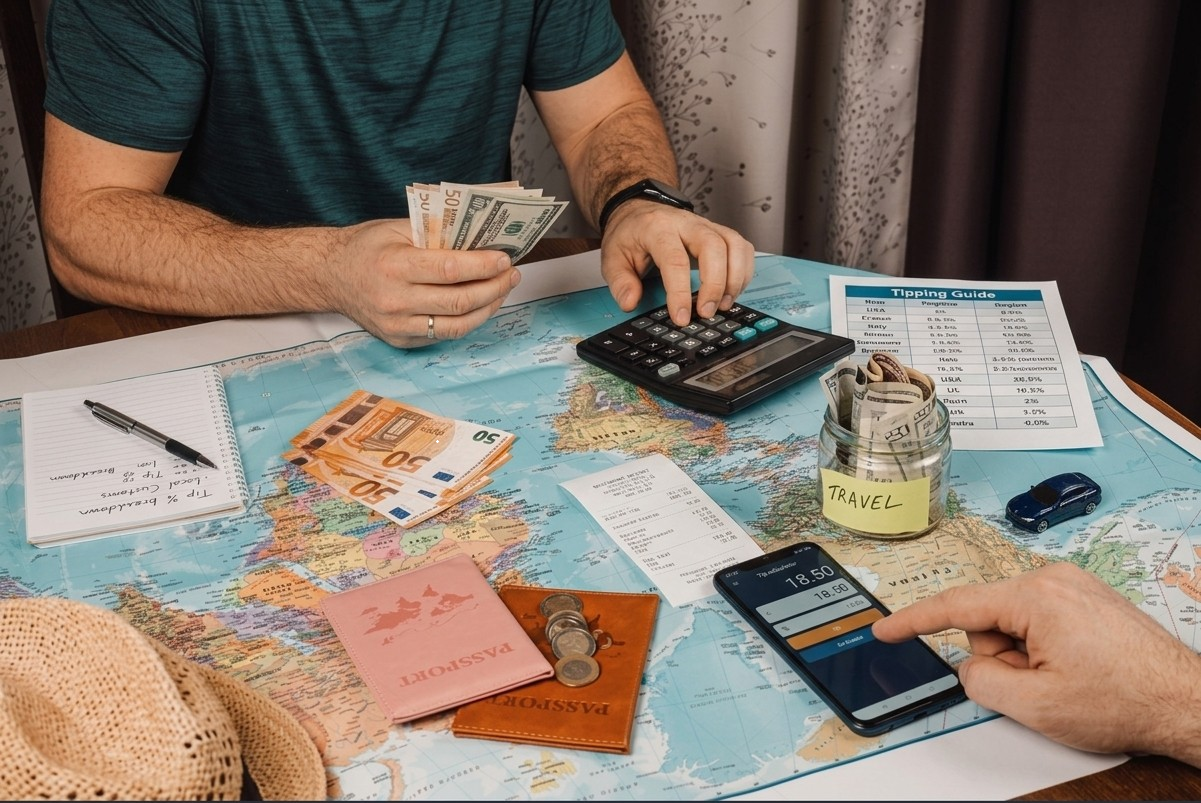
One thing worth knowing if you travel: tipping isn't universal. Fifteen to twenty percent is the norm in the U.S., but in a lot of Europe and Asia the service charge is already baked into the price, so tipping big is either unnecessary or mildly confusing to the staff. I found this out the awkward way in Tokyo, trying to leave extra cash on the table, which apparently isn't really a thing there. Tax works similarly — some places show you the price already including it, others slap it on at the register, which is its own kind of surprise if you're not expecting it.
- United States: 15–20% tip, tax added at checkout
- Europe: Service charge often included, 5–10% for exceptional service
- Japan: No tipping expected, tax usually included
- Australia: No tipping culture, tax included in displayed prices
- UK: Service charge sometimes included, 10–15% optional
None of this requires a special app or a math degree. It's three moves: tip on top, tax on top, then divide — and after doing it a few times by hand, you stop needing to think about it at all. You just know.
Quick Reference Table
| Bill Subtotal | Tip 15% | Tip 18% | Tip 20% | With 8% Tax + 18% Tip |
|---|---|---|---|---|
| $20.00 | $3.00 | $3.60 | $4.00 | $25.49 |
| $35.00 | $5.25 | $6.30 | $7.00 | $44.60 |
| $50.00 | $7.50 | $9.00 | $10.00 | $63.72 |
| $75.00 | $11.25 | $13.50 | $15.00 | $95.58 |
| $100.00 | $15.00 | $18.00 | $20.00 | $127.44 |
| $150.00 | $22.50 | $27.00 | $30.00 | $191.16 |
| $200.00 | $30.00 | $36.00 | $40.00 | $254.88 |